Home
HomeScientific Questionnaire
This questionnaire was elaborated in the framework of the scientific project for the years 2018-2020, entered in the State Register of Science and Innovation Projects with the code 18.80013.0807.06.STCU / 6336 "Innovative approaches to applied computations and software development for gender equality regulation on labor market", within the framework of the STCU-ASM Joint Research-Development Initiatives Program, the call from 10.04.2017.
The purpose of this questionnaire is to find out what are the views of the employees are on the status of gender equality in the workplace in the organizations in which they work.
245 respondents from the Republic of Moldova took part in the survey, of which,
- by gender: the share of male respondents – 46.6%, female respondents – 53.4%;
- by age group: under 35 years old – 44.3%, from 35 to 50 years old – 32.1% and over 50 years old – 23.6%;
- by education level with higher education: licence/master degree - 56.4%, doctorate/postdoctorate – 39.8%; other education levels – 3.8%
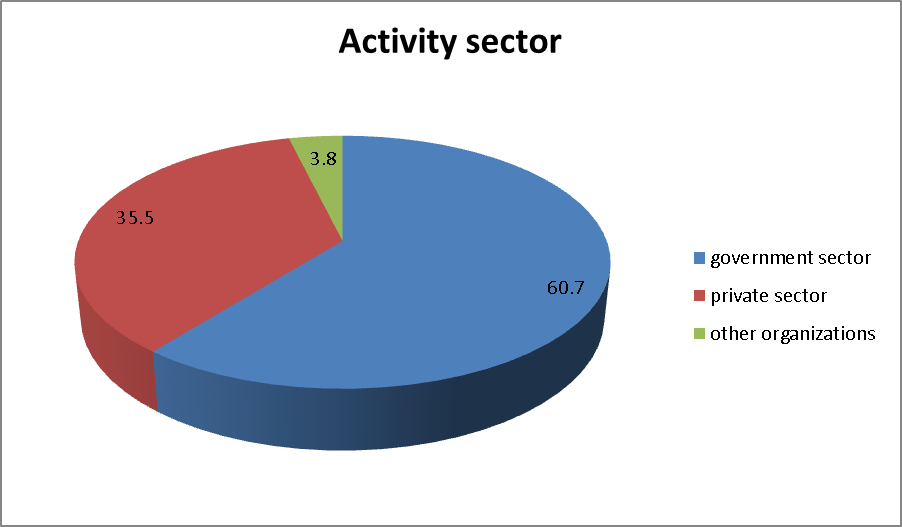
- by activity sector: government sector – 60.7% of people, from private sector – 35.5% of respondents, other organizations - 3.8%
- by function at the organization where the respondent works: ordinary employee – 59.7%; Director / Manager or their deputies – 18.5%; Head of economic service or his / her deputy (accountant, economist, financier, marketer, supplier) – 11.4%; Head of human resources department or his / her deputy – 1.9%; Head of engineering service or his / her deputy (engineer, technologist, designer, electrician, IT specialist) – 6.2%; Other – 2.4%.
- by the ratio between men and women in the organization: Nearly all are men – 2.8%; More are men – 14.7%; Number of men and women is nearly equal – 34.1%; More are women – 39.3%; Nearly all are women – 9.0%.
First set of questions: GENDER INEQUALITY
The majority of the respondents (71.6%) stated that the issue of gender inequality is not present at their workplace, while only 16.6% confirmed it’s existence at their job.
In your opinion, is the issue of gender inequality present at your workplace? (
When asked about personal encounter of gender discrimination half of them (52.1%) said they didn’t encounter it at all, a little more than a quarter (28.8%) faced discrimination in daily life and only a small share of respondents faced it in their organization (3.2%) or another organization (16.0%).
Have you personally faced gender discrimination?
At the question if they knew cases of gender discrimination when applying to a job the answers were practically divided in half (48.3% of respondents negated, while 41.2% confirmed knowing such cases). When asked about knowing of gender discrimination on pay cases only a quarter of respondents (28.9%) confirmed, while more than a half (55.4%) said they didn’t know such cases. In the case of gender discrimination when advancing in a work position more than a third (39.3%) stated that they have knowledge about these cases, while half of the respondents (48.8%). Another situation is in the case of gender discrimination in providing childcare leave for fathers/mothers the majority of them negated (68.7%) about knowing of such cases.
Do you know cases of ...
After being asked about the presence of the issue of gender inequality in the organization where they work the majority of respondents negated it, regardless of the type of issue.
In your opinion, is the issue of gender inequality present in the organization in which you work?
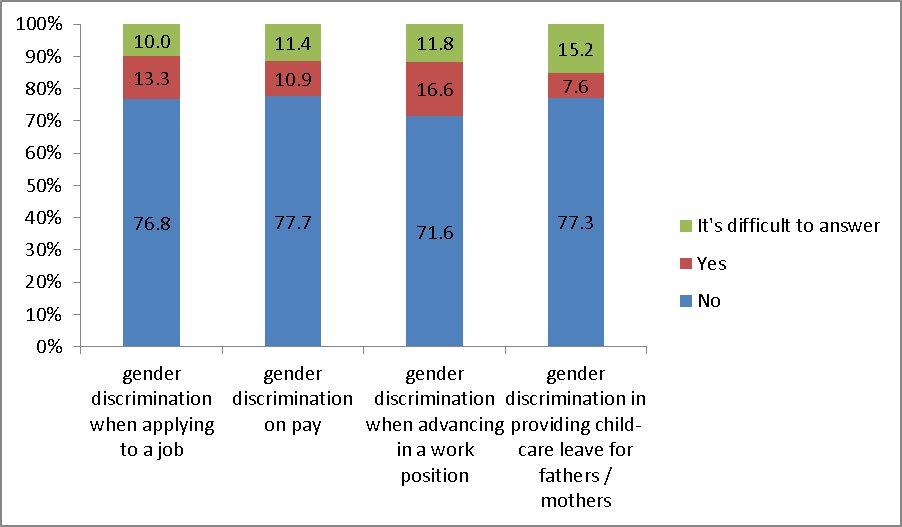
When the respondents were asked about assessing the severity of gender inequality in the organization where they work regardless of the type of gender discrimination the majority of the respondents stated that it doesn’t exist. A small share of respondents said about the presence of strong or very strong gender inequality (<5%). A bigger share of respondents assessed the severity of gender inequality as being moderate, more for gender discrimination when applying to a job (8.5%), for gender discrimination on pay (6.2%), for gender discrimination when advancing in a work position (5.7%) than in the case of gender discrimination in providing childcare leave for fathers/mothers (2.8%). Varying slightly by type of gender discrimination,
8-13% of respondents stated that the gender inequality severity at their organization is weak, while 13-18% said it’s very weak.
Assess the severity of gender inequality in the organization where you work
What other kinds of gender discrimination did you also meet or know/hear?
- Sexism
- Indicating the required gender in the job announcements for the employees
- Discrimination of women with young children and women who have just come out of maternity leave at hiring
- Discrimination at getting leave for the care of a sick child up to ”being fired at will”
- Sexual harassment, mobbing
- Gender discrimination regarding the perception of women in managerial position
- Offenses in traffic against women drivers
- Discrimination of men through gender quotas
- Assignment of tasks not mentioned in job description for men in facility management
- Discrimination of employees with families with many children
- Nepotism
- Positive discrimination
- Receiving non-material benefits
- Discrimination against married women
- Separation in women professions and men professions (men drivers, women to kitchen)
- Gender discrimination when applying for qualification courses
- Discrimination by age, by spoken language, by sexual orientation, ethnicity
I know and hear about the oppression of women at work: the requirement of the boss to engage in sexual relations so as not to lose her job. And this is a very common occurrence. In Moldova, this phenomenon is very hidden and is not yet discussed in the press, only on the sidelines. (Female, over 50 years old)
Gender quotas that discriminate against men [...] require the promotion of women without taking into account the merits, the capacities and the passion for the respective work. (Male, 35-50 years old)
In the absence of the special staff employed to perform facility management tasks, these tasks are assigned to men without being mentioned in the job description and without being paid (maintenance of the company car without a driver, maintenance of the heating system, generator, air conditioning, etc.). (Male, 35-50 years old)
As a father, they did not give me an insurance medical policy for a child in a clinic, even though they had my passport, an old medical policy, and even though they had the child, they demanded mother to come, at my demands they told me that I, as a father, had the same rights, [but] they say this is the instruction. (Male, over 50 years old)
Female [medical] consultations are free for women, for men there are no male consultations - andrologists and sexologists, as a rule, are all paid, as if a man does not in any way take part in the reproductive process. - This is discrimination based on gender. (Male, over 50 years old)
[Women are discriminated] When distributing work tasks and involving only women in office cleaning; making decisions during activities that women do not participate in (e.g. "to soccer with boys"). Some abilities are attributed to men only because they are men (e.g. smart, risky) and women (e.g., earnest, caring). (Female, 35-50 years old)
Faced with the fact that when applying for a job, they immediately said that I would soon go on maternity leave ...  (Female, 35-50 years old)
In some projects, only men or only unmarried women were selected, because married women do not have time to get involved as much in the project. (Female, 35-50 years old)
[I]t is true that some jobs are really not for women, even if they consider it to be discrimination. It is strange to see a woman driving a TIR truck, but, physically, she is not able to remove any minor damage that could be repaired by a man. (Female, 35-50 years old)
The society is full of outdated patriarchal concepts which is reflected on all spheres of life and creates impediments in the intellectual, spiritual and entrepreneurial development of women. (Female, under 35 years old)
Often, gender discrimination is exacerbated by other types, namely: - on a linguistic / ethnic basis; - by age (they do not hire over a certain number of years - 25, 30, 35 - despite their high qualifications. And old women pensioners are not considered at all, except in the case of favours); - by education (although there are such self-taught people who will give a hundred points handicap [to surpass significantly] to diploma holders) (Female,over 50 years old)
I don’t know / didn’t hear about others, namely gender. But about others, such as by age, by education, by nationality - it was. Sexual harassment, of course, is not relevant here, but I know about this kind of pressure and even blackmail on women. (Male, over 50 years old)
[There is discrimination based on] [s]exual options, convictions, religion, nationality and ethnicity (e.g. gypsy), region (e.g. Moldovan), income and status, townsman-peasant differences, favours, etc. (Female, 35-50 years old)
Second set of questions: Flexible Schedule
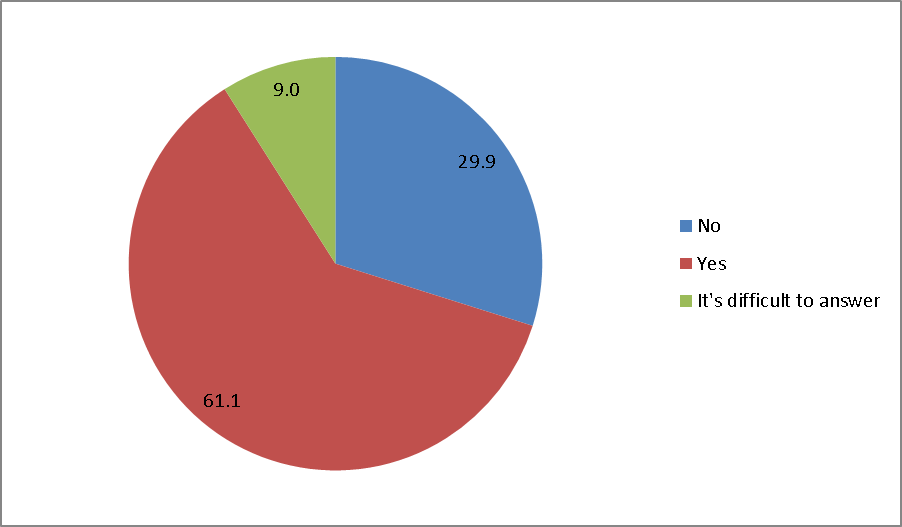
Even though the majority of respondents (61.1%) stated that they know about the legal right to work with a flexible schedule, only a half of the respondents state that employees from respondents organization (46.4%) use it.
Do you know about the legal right to work with a flexible schedule?
Do the employees of your organization use flexible working hours?
Third set of questions: CHILDCARE LEAVE
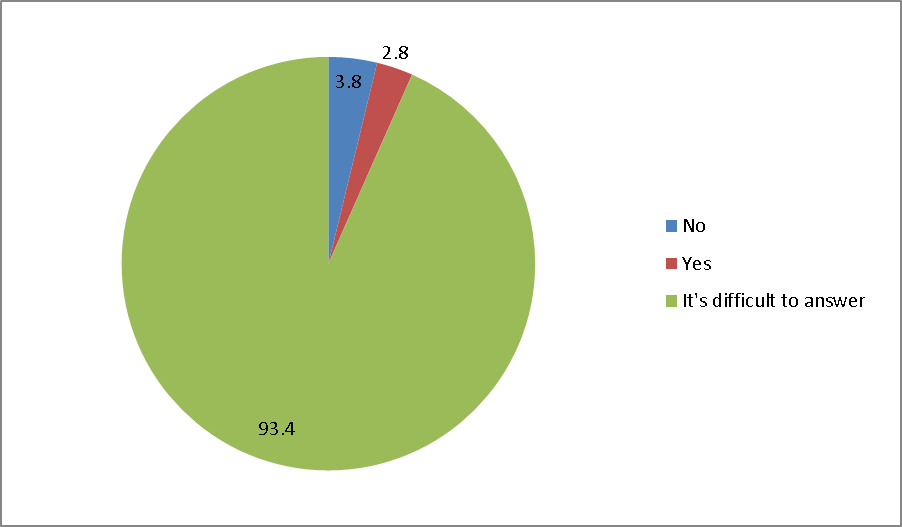
The majority of the respondents (93.4%) found difficult to answer whether they are aware of the legal right of men to paternity leave (child-care leave).
Are you aware of the legal right of men to paternity leave (child-care leave)?
A third of respondents (36.5%) stated that men don’t use the right to take child-care leave and only a fifth of them (21.8%) stated that men use it.
Do men use the right to take child-care leave?
When asked about the impact of more active use of childcare leave by men on the diminishing discrimination of young women at hiring, half of respondents (49.8%) didn’t knew, while a fourth of them (23.2%) said it won’t have an impact, while another fourth of people (27.0%) stated it will be a positive impact.
In your view, if men will use more actively the right to paternity leave, will it change the idea of employers that it is unprofitable to hire young women because they are potential mothers and may be absent from work for a long period (maternity leave, child illness, etc.)?
Fourth set of questions: GENDER QUOTAS
The majority of the respondents (62.1%) didn’t know about the existence of gender quotas.
Do you know about the existence of gender quotas?
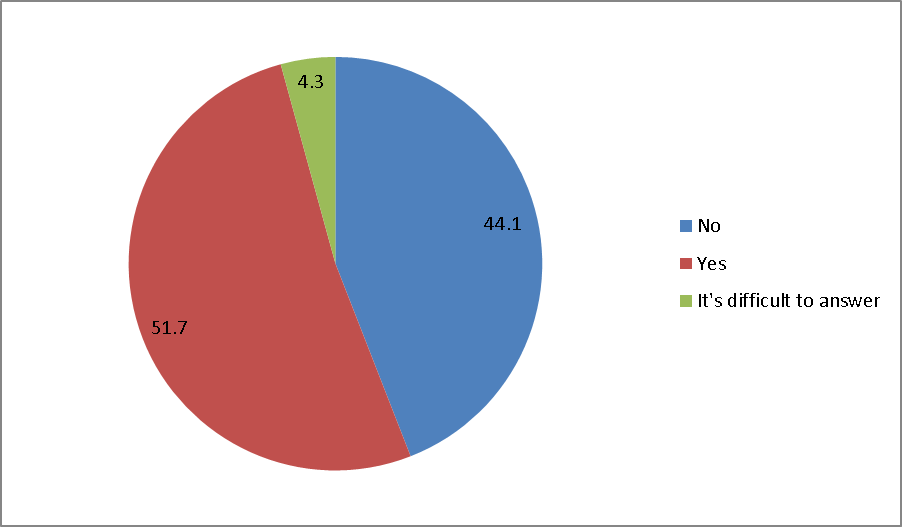
When asked if the enterprise where they work apply gender quotas at employment respondents’ answers were divided. Half of them (51.7%) said that they apply, while 44.1% stated that they don’t.
Does your enterprise apply gender quotas at employment?
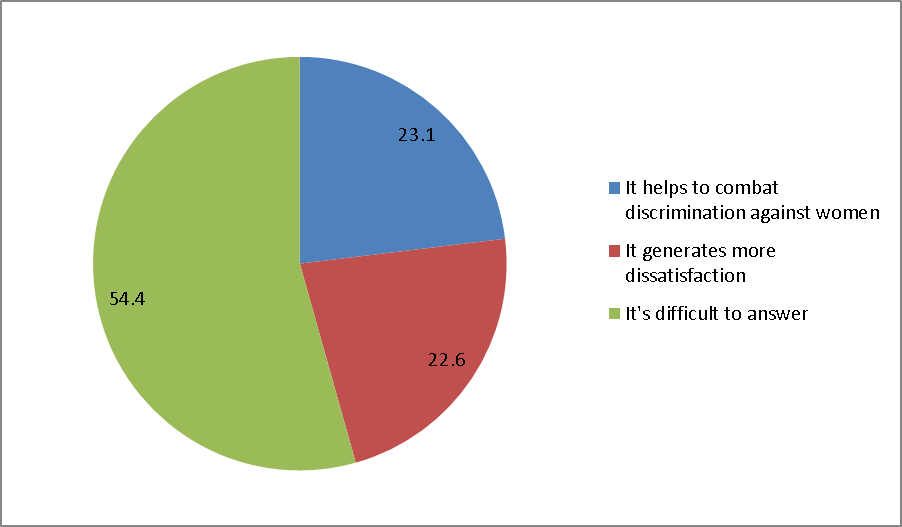
A little more than a half (54.1%) of respondents found difficult to answer about what is the impact of gender quotas on gender discrimination, while the opinions on positive or negative impact were divided: the ones who considered that quotas help combat discrimination against women accounted for 23.1%, while the ones who stated that quotas bring more dissatisfaction had a share of 22.6%.
In your opinion, what is the impact of gender quotas on gender discrimination?
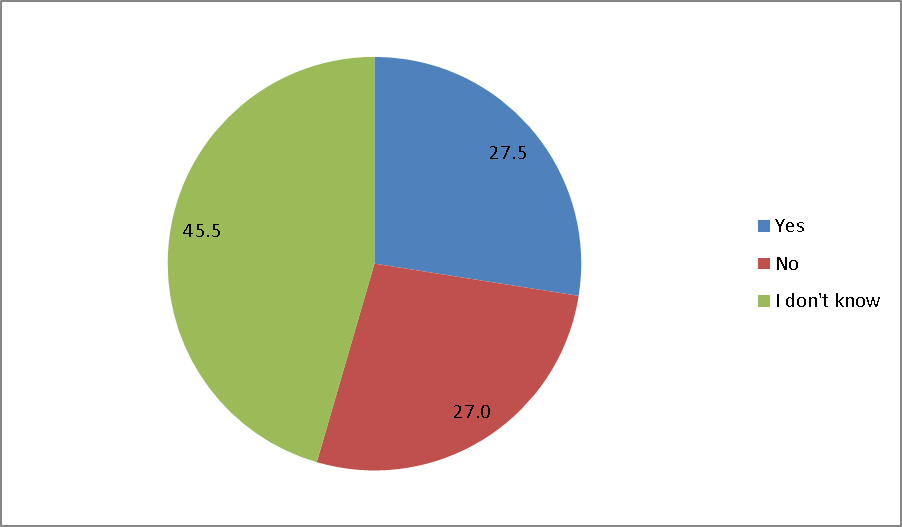
Referring to improving existing ratio between women and men in the management of the companies almost half of people said they didn’t knew how gender quotas would impact this, a fourth of respondents (27.5%) considered quotas to be capable of improving the existing ratio between women and men, while another fourth (27.0%), on the contrary, stated the quotas won’t cause improvements.
Are gender quotas capable of improving existing ratio between women and men in the management of the companies?
At the question of the importance of the gender equality being ensured in the enterprise where they work a big part of the respondents considered it very important (40.3%) or important (32.2%), while a minority of them (7.1%) stated that is of a little importance and a half of the respondents (20.4%) said it wasn’t important at all.
How important is it for you that the gender equality is ensured in the enterprise where you work?
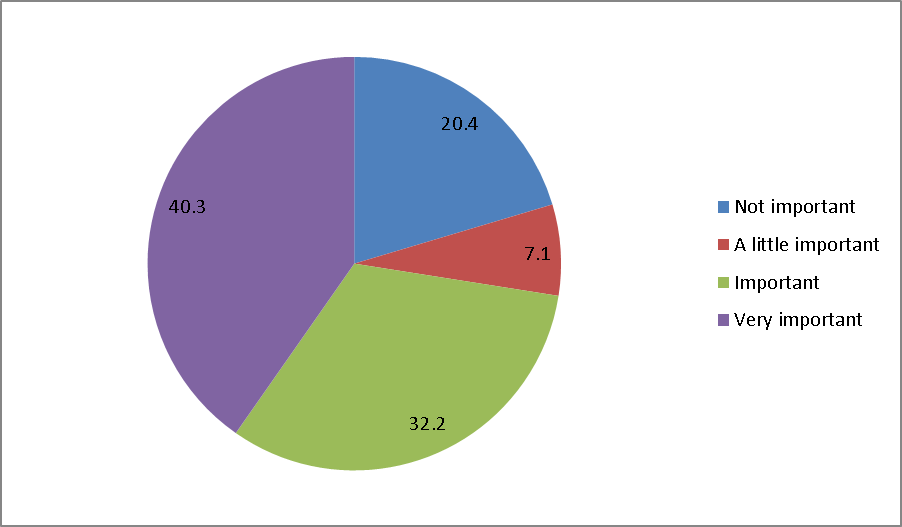
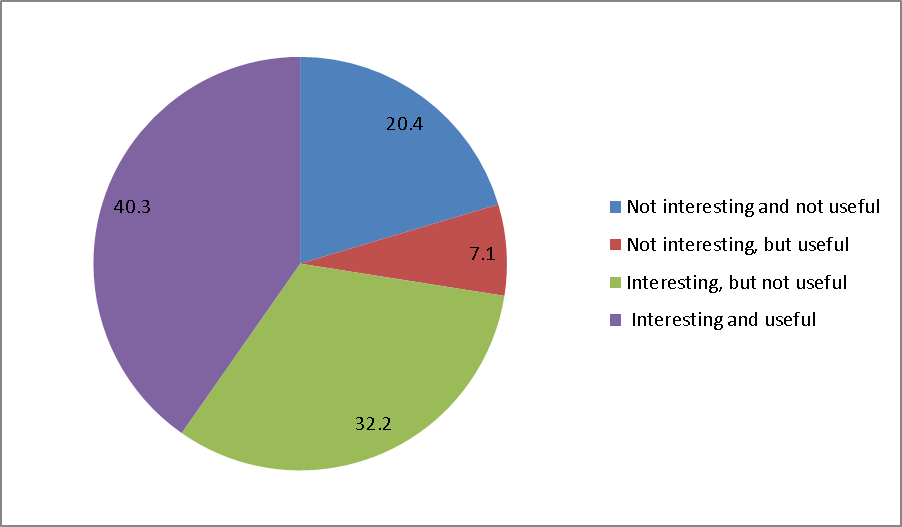
About the interest and usefulness of a gender analysis (audit) at the enterprise where the respondents work, 40.3% found it interesting and useful, 32.2% - interesting, but not useful, while 7.1% considered it not interesting, but useful and 20.4% - not interesting and not useful.
In your opinion, doing a gender analysis (audit) at the enterprise where you work is...